The situation
Running an independent festival means coordinating dozens of moving parts at the same time. Artists with riders, contracts, technical requirements, and performance schedules. Hundreds of volunteers across multiple shifts and roles. Multiple bars, each with their own stock lists, menus, staff rosters, and cash floats. A production budget pulling together ticket sales, bar revenue, merch income, grant applications, and supplier costs. And on the day itself, radio channels, run sheets, and incident reports all need somewhere to live.
Most festival organisers manage all of this through spreadsheets. Powerful in isolation, but siloed, error-prone, and completely useless to a team standing in a field with a phone. Dedicated tools exist for ticketing or scheduling or contracting, but they don't talk to each other. Enterprise event software covers everything but costs £15,000 to £50,000 a year, was designed for conferences, and bends the wrong way for festivals.
The client needed one platform that covered the entire event lifecycle. First budget line to post-event report. Affordable enough for independent promoters. Opinionated enough to actually speed things up rather than just digitise the same mess.
What we built
A complete operations platform with 30 feature modules covering every part of running a festival.
The lineup management system lets organisers schedule artists across multiple stages in a visual timeline grid with drag-and-drop reordering. Each artist profile tracks fees, set times, technical requirements, crew numbers, green room assignments, and sound check slots. Artist images and genre data pull automatically from Spotify. A public lineup page generates through a secure shareable link with no login required.
The bar and point-of-sale system is the most complex single module. Each bar operates independently with its own menu, stock levels, staff, and cash float. Tabs open, items add, tabs settle or void, and every transaction records for financial reporting. Stock management tracks what you have, takes point-in-time snapshots, and generates buying lists for procurement by comparing current levels against expected demand. Bar revenue feeds directly into the event budget. For festivals, bar income typically accounts for 40 to 60% of gross revenue. Having accurate, real-time figures changes financial decisions on the day.
Volunteers register through a public portal, get assigned to shifts, check in via QR code on their phone, and can request shift swaps that go through an approval workflow. Automated reminder emails go out before shifts start.
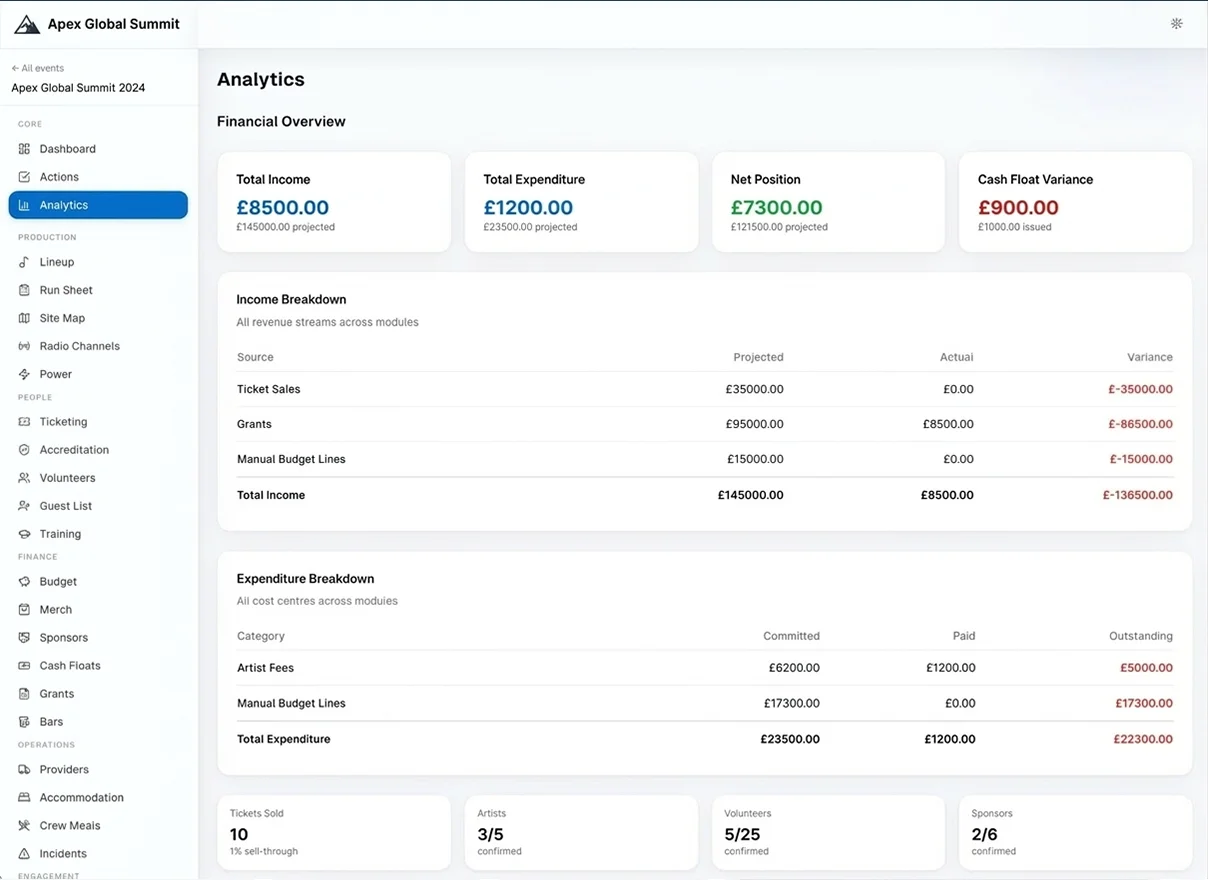
The budget module combines income lines, expenditure, bar revenue, merch sales, and grant applications into a live profit-and-loss view. Projections link to real financial data as it comes in. This replaces the shared Google Sheet that most festival producers use as their financial control room.
Contracts generate from templates using the platform's data, go out for e-signature through BoldSign, and track status automatically through webhook callbacks. No more emailing PDFs back and forth.
Ticket data syncs from Ticket Tailor through a live API integration, pulling event and ticket type information into the platform automatically. Accounting data exports to Xero through a full OAuth connection with journal entries and contact records.
Artists, providers, and volunteers each get their own self-service portal secured with a signed token. No account creation needed. Artists submit their advance requirements directly into the platform. Providers confirm their details. Volunteers sign up for shifts. All of it flows into the same database, so the budget reflects real numbers and the day sheet reflects real schedules.
The numbers
| Traditional agency | Tyree Digital | |
|---|---|---|
| Cost | £97,000 to £155,000 | £7,500 |
| Timeline | 12 to 18 months | 15 days |
| Speed | 1x | 24 to 36x faster |
| Saving | Up to £147,500 (95%) |
The platform delivered 46,839 lines of production code across 167 commits. 156 API endpoints. 62 database models. 30 feature modules. Six distinct public-facing portals. All built with row-level security at the database layer, meaning even a bug in the application code cannot leak one organisation's data to another.
If licensed to a single festival group, the platform would command £15,000 to £25,000 in year one with annual maintenance fees of £3,000 to £5,000 thereafter. Against the £7,500 build cost, that returns 300 to 567% from a single customer over five years.
What the client owns
A fully self-contained software asset. The code, the database, the integrations, the contract templates, and every piece of operational data. No agency relationship required to keep running. No vendor who can change pricing or discontinue a feature. Every artist database, supplier list, volunteer roster, and budget template the organisation creates within the platform stays within the platform, building value with every event.
The subscription tier system and feature flag architecture mean the platform can operate commercially from day one. A free tier with limited modules feeds into paid tiers without any code changes. That's an acquisition funnel built into the product itself.
What happens next
A monthly subscription covers hosting, maintenance, and ongoing development. The platform is built to grow with the client. Multi-event analytics, additional integrations, and expanded reporting all build on the existing architecture. As organisations run more events through the platform, their historical data becomes increasingly valuable and increasingly difficult to replicate elsewhere.